
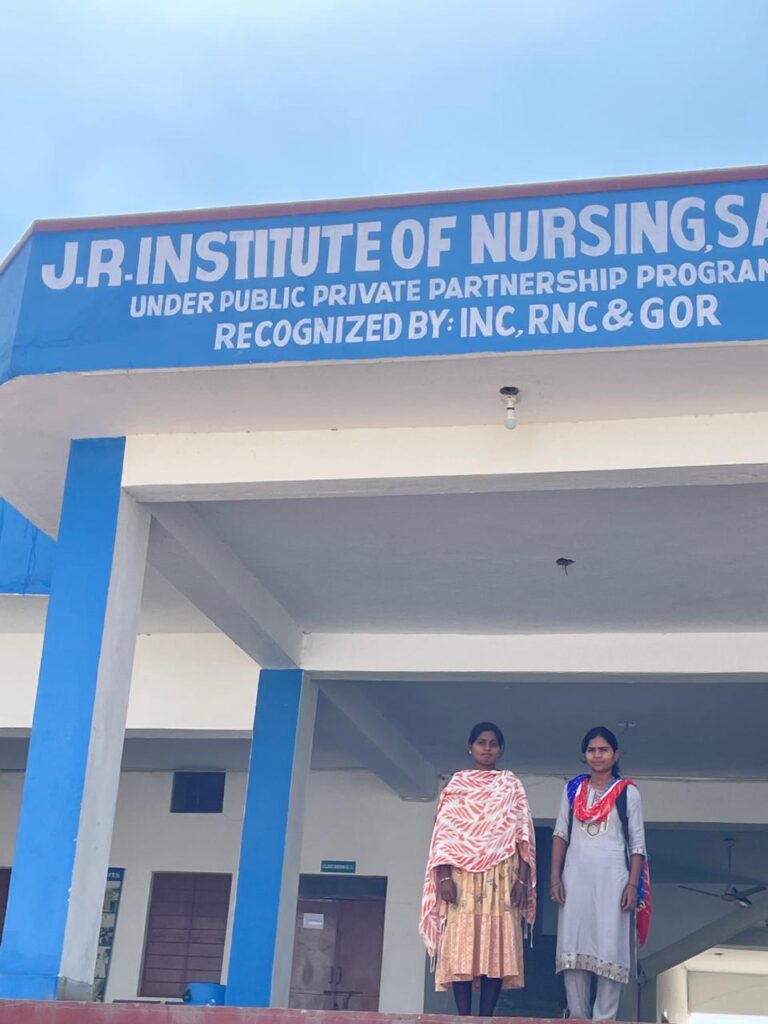
An inside story of two young women who said yes to nursing college, uncertainty they faced, and a life they hadn’t yet imagined
Some time ago, we began working on an idea: to support young women from tribal communities in pursuing careers in healthcare, especially nursing. The idea emerged from a challenge we repeatedly faced at our clinics in the Gogunda cluster – finding and retaining nursing staff in remote areas. Many nurses came from far-off districts and often struggled with long commutes, limited transport, and the difficulty of being away from home for extended periods. Over time, this also made us think more deeply about the value of building a local healthcare workforce, young women who not only understood the language and realities of the community, but could imagine a future for themselves within it.
The motivation was simple, to open up opportunities for young women, those who may not otherwise have access, and to strengthen the health system with women who understand their communities deeply.
It has now been a year since Leela and Movni, two young women from remote tribal villages of South Rajasthan embarked on a new chapter in life as they joined a nursing college.
I often find myself returning to that time: the uncertainty, the waiting, the anxiety of checking merit lists, and the small moments of hope that kept us going. Back then, it felt like we were trying to get two girls through a complicated admission process. But a year later, I see it differently. It was never just about admissions. It was about perseverance, hope, quiet courage – theirs and in some ways, ours too.
Both Leela and Movni come from rural agricultural families where higher education opportunities, especially for young women, remain limited. Both were already married and their days were largely shaped around attending school and carrying out household responsibilities. Professional education, particularly something that required moving away from home, felt distant, not only geographically but socially as well.
We began by meeting girls from villages near our AMRIT Clinics in Rawachh, listening to their aspirations, understanding their interests, and trying to gauge their commitment to this path. After several conversations, we selected a few girls who seemed ready to take this leap.
What followed was a long and often frustrating admission process, filling forms for both ANM and GNM courses, gathering documents, and navigating eligibility criteria that often felt more confusing than clear. And then came the waiting.
Because admissions are based on their scores in high school, there was always an underlying anxiety: would their marks meet the cut-off? The first GNM merit list came out, their names weren’t there. Nor were they on the second list. In between, we travelled to the district office to understand the ANM admission process, which was entirely offline and difficult to navigate. We eventually learnt that the cut-offs were too high for them to qualify. Disheartened, but not ready to give up, we continued waiting for the next GNM list.
Weeks later, the third list was released. I scrolled through nervously, looking for familiar names and IDs. And there they were, Leela and Movni had made it.
The joy was immediate, but so were the questions. The college was far, in another district. Would they be willing to move 200 kms away from home? I called to share the news and asked if they were ready for this step. There was some hesitation, buy they said yes.
Looking back, that “yes” holds so much within it. It was a yes to uncertainty, to distance from home, to navigating unfamiliar spaces. It was also a yes from their families, a willingness to let them step out, continue studying after marriage, and imagine futures that extended beyond the boundaries of their villages.
A year later, what stays with me is not just that moment of admission, but everything that has followed.
Leela and Movni have stayed the course. They have shown up, day after day, trying to learn, to keep up, to do their best in a space that is still new and demanding. And in quieter ways, I have also seen them change. They now travel independently across districts, navigate hostel and college life far from home, manage administrative processes on their own, and seem more aware of possibilities beyond what once felt imaginable.
Movni’s story, in particular, carries many layers. She lost her father at a young age, after which her mother remarried, and much of her upbringing was under the care of her maternal aunt and uncle. Over the past year, she became a mother to a baby girl. And yet, she continues her education, holding together both roles with a strength that is difficult to capture in words. Equally important has been the support from her family, especially her husband and younger cousin, who supported with caregiving responsibilities to ensure that her studies could continue. In contexts where women’s aspirations are often the first to be compromised, this kind of family support gives hope.
I realise now that while getting their names on that list felt like the hardest part then, staying on this path requires a different kind of resilience.
As someone who holds much more privilege, I often think what it means to stand alongside women who haven’t had the same opportunities. What does it mean to truly support, without overshadowing? To stand alongside, rather than lead? I don’t always have clear answers, but I am learning that sometimes, it is about showing up consistently, navigating systems together, and holding space through uncertainty.
On this Nurses Day, I find myself thinking not only about the profession itself, but also about the journeys that bring so many young women into it – the distances travelled, the responsibilities carried quietly alongside education, and the many forms of support that make staying possible.
Leela and Movni’s journeys are still unfolding. And perhaps our work is simply to keep widening that doorway for them and many others.
Written By : Ashmita Gulechha (Executive, Research & Policy)