
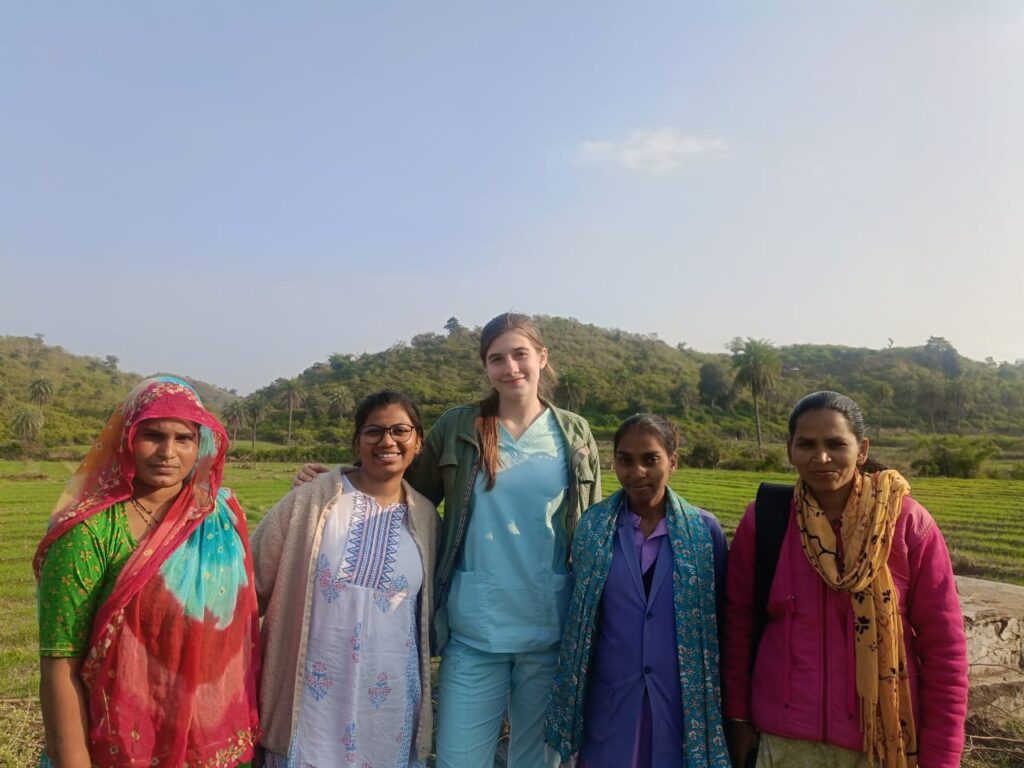
It’s early in the morning, and I am sitting in the back of an ambulance with four of the
most inspiring women I’ve ever met. These women are community health volunteers, nurses, and
interns, each contributing to a support system whose necessity and effectiveness I came to
understand during the three days I spent with Basic Healthcare Services.
We are on our way to a small village in rural Rajasthan where Basic Healthcare Services
is hosting an ANC (antenatal care) day for the local women. Upon arrival, we approach a young
woman sitting on the front steps of her house and inquire as to how many pregnant women live
in the village and where they are located. She provides us with several names and we set off,
visiting each recommended house to explain the ANC day’s purpose, where it will be held and
when, and inviting them personally to join. Some of the women we speak to are reserved and
initially seem hesitant. Slowly, the community health worker, through conversations, jokes, and
blatant kindness, gains their trust and, thus, their participation. When the clinic actually begins,
the number of attendees increases steadily until we are surrounded by an attentive group.
As a visiting researcher, I was fortunate to spend several days at Basic Healthcare
Service’s various clinics, working alongside their commendable teams of doctors, nurses, and
community health volunteers. While each day brought new lessons, observations, and touching
moments of care and kindness, I have chosen to focus on my third, and last, day with Basic
Healthcare Services – when they held the ANC day – in my reflection, for I feel that it was a
special insight into the community-rooted, compassionate approach that defines the
organization’s work and impact.
The ANC day itself is a testament to the benefit of informed care in a community context.
An intern explained that by providing this information and these medical tests in a group setting,
women who are uncomfortable answering specific questions or giving blood, for example, can
observe some of their peers and become more at ease. Despite having been involved in a variety
of maternal health initiatives, this was the first I had heard of such an approach, and I was struck
by the ingenunuity of it and its real-life effectiveness: When a more extroverted mother
volunteered to be tested first, the expressions and posture of several women, upon witnessing her
be administered the exam, visibly relaxed.
The Basic Healthcare Service maternity care model is strengthened by close collaboration
between organizational staff, nurses, and community health volunteers. While both nurses and
volunteers speak the dialects of the communities with whom they are working, the community
health volunteers frequently know the villages well, and are acquainted with at least several
people in each. One such acquaintance on ANC day was an Anganwadi worker, who joined us
during our recruitment of attendees and contributed to the day’s activities immensely. Many of
the expectant women already had children, which assumedly made attending the ANC day more
logistically complex. The Anganwadi worker gathered the children together and engaged them in
a number of lively activities. This served the dual purpose of enabling the mothers to receive
care unimpeded, while also helping cultivate a lighthearted atmosphere as we laughed along to
the children’s antics.
The cheery atmosphere of ANC day was something that particularly struck me, and
signaled the ease the attendees increasingly felt with the Basic Healthcare Services team. One
moment in particular occurred during the second half of the ANC day, when the women were
asked to step on a weighing scale. The children were also weighed, yet were not able to stay still
long enough for the scale to accurately read their weight. What ensued was a series of humorous
disruptions – mothers having to hold their children to get weighed, the children running off the
scale – that made everyone laugh together. Watching this progression in the women’s comfort
was truly lovely, and helped transform the ANC day from simply a medical clinic to a
community event.
In addition to social ease, it became clear that, as the clinic went on, more women felt
able to confide in, or seek more personal information from, the Basic Healthcare Services team.
Two women, brought to the clinic by the Anganwadi worker, asked the community health
volunteer to inform them of contraceptive options. Other women began to ask more questions
about hygiene, complications, and individual ailments. They were answered with thorough
responses. Within only a few hours, the level of trust had notably increased.
At the end of the clinic day, however, something unexpected occurred. An older woman,
brought to the ANC day by a Basic Healthcare Service mental health professional for
examination, began to experience a severe seizure. We rushed to her aid and, once she was
stable, brought her back to her home to rest. Upon speaking with people in the village, we
learned that she was a social outcast due to her epilepsy, cut off from friends, family, and,
subsequently, care. When I later discussed this incident with members of Basic Healthcare
Services, they explained that they would follow up with her and provide her with additional
support. Basic Healthcare Service’s response to this incident highlights how the organization’s
infrastructure and care model enable them to aid communities on multiple levels and in
numerous ways, a range and depth of care that is inspiring to observe.
My time with Basic Healthcare Services was both uniquely compelling and informative.
With the guidance of the team, I gained in-depth knowledge about not only the work at hand, but
the social rationale behind each approach, the complexity of maternity care provision in rural
India, and, perhaps most importantly, just how impactful a conversation between patient and
provider can be. As Basic Healthcare Services shows, the most important building blocks in
healthcare are sometimes the simplest: compassion, patience, and persistence.
Written by : Victoria Semmelhack