
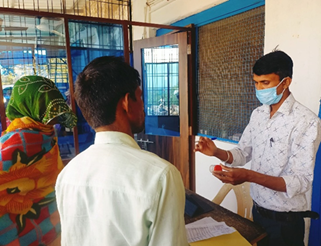
In the Salumber district of Rajasthan, AMRIT clinics collectively serve a predominantly tribal population, spread over the remote and difficult terrains of Southern Rajasthan. The communities in this region face a convergence of structural vulnerabilities. Small landholdings and erratic rainfalls force many men to migrate to cities for manual labour.
Poor availability of nutritious food, coupled with hazardous work lead to a high risk of tuberculosis among these populations. Once infected, distances to health facilities and limited transport makes it difficult to timely access diagnostics and treatment. Stigma associated with TB also makes it difficult to seek help. All these factors lead to the disease continuing to transmit among families and communities, further increasing their vulnerability.
Three AMRIT Clinics serve these populations and receive large numbers of people affected with Tuberculosis. Some people travel from as far as 70-80 kilometres to access the treatment, reflecting the scarcity of services and the trust people have in AMRIT Clinics.
What care do AMRIT Clinics provide for people affected by Tuberculosis?
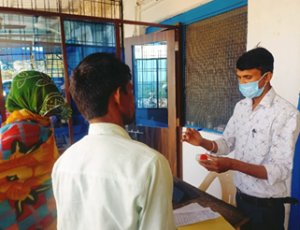 The Clinic teams provide empathetic care and an environment where people feel comfortable sharing about themselves and their illness. For TB, the care includes assessment for TB and associated morbidities, collection of sputum samples, medication for the disease and co-morbidities, nutrition supplementation, and mental health assessment and counseling.
Till a year back, after the initial assessment, patients had to get an X-Ray
done from a private clinic, and bring the sputum sample in the next visit, a week later. The sputum sample was then sent to a city lab, which took another week. This led to enhanced costs, delayed initiation of treatment, and sometimes dropping out of the treatment. For many households, these delays translate into additional out-of-pocket expenditures and lost wages, further impacting care-seeking and continuity.
Integrating technology with primary care management of Tuberculosis
To strengthen early detection, clinical decision-making, and to reduce financial burden on patients, BHS, with the support of Molbio Diagnostics, introduced an AI-enabled, ultra-portable X-ray machine. The system has been introduced in all three AMRIT clinics in Salumber. This is coupled with the TRUNAT molecular diagnostic machine with the aim to reduce fragmentation in the diagnostic pathway and shifting services closer to the community.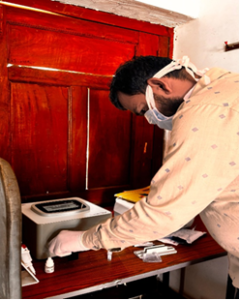
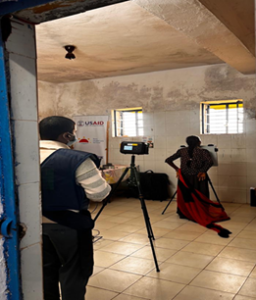
Since both machines are portable, a radiographer and a lab technician carry the machines to the Clinics on specific pre-fixed days, and conduct X-Rays and sputum testing, on site. The time to diagnose has reduced from 14-21 days earlier to 1-7 days after the introduction of the bundle of diagnostics.
How is the integration helping care for TB patients?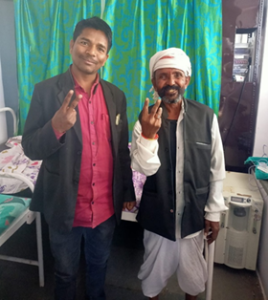
Overall, the combined deployment of AI-assisted imaging, decentralised molecular diagnostics, nutritional supplementation, mental health assessment and management, and community-based follow-up mechanisms is leading to measurable strengthening of the TB care cascade in Salumber. It is also leading to a model of such care for other similarly marginalized communities that combines compassion, technology, and management.
Written by the TB diagnostic research team, BHS.