- 0294-2453392
- info@bhs.org.in
- Badgoan Road, Udaipur - 313001

Context & Story
BHS works in the southern part of the Rajasthan. Spread across six districts with predominantly rural population, nearly 60% of South Rajasthan is tribal and constitutes hilly, remote, sparsely populated villages (population density of 200 per square km). The least developed region in the state of Rajasthan, the south has an average human development index score of 0.5 (Government of Rajasthan 2008).
BHS focuses its efforts primarily in the districts of Udaipur and Dungarpur. A recent expansion includes the newly designated Salumbar district, which was formerly part of the Udaipur district.
Rural and tribal communities, such as those we serve bear a disproportionate burden of ill health. Their lives lie at the intersection of high impoverishment, critical dependence on migration, and lack of access to healthcare. This is reflected in in high levels of morbidity and in large disparities in mortality. For example, in our baseline study of four underserved panchayats in South Rajasthan, we found that a whopping 68% of all children reported falling ill at least once in the previous two weeks. In such areas, public health services either do not exist or are affected by absenteeism of physicians and nurses. The formal private sector also does not reach this area as people have very limited ability to pay. In such conditions, unqualified private practitioners and traditional healers are the default care providers—often of poor quality and exploitative, but available.
The region has undergone a near-complete loss of traditional forest-dependent livelihoods, high levels of water scarcity, and an absence of alternative employment opportunities. Up to 80% tribal households send at least one member (typically, male) to the labour markets in Gujarat and beyond out of sheer economic distress. The state government estimates about 130,000 children from the region migrate every year in search of work, although the actual figures are expected to be much higher. Yet, the income earned from migration is inadequate to pull households out of poverty. Faced with high disease burden, indebtedness and low productivity, families left behind by migrants are unable to negotiate healthcare as well as other social security entitlements.
Moreover, in the absence of male members, the burden of household responsibilities disproportionately falls on women, compelling them to juggle a myriad of tasks. From managing the intricacies of farming to tending to livestock, gathering firewood, and overseeing the intricate art of cooking, women find themselves immersed in a multitude of roles.
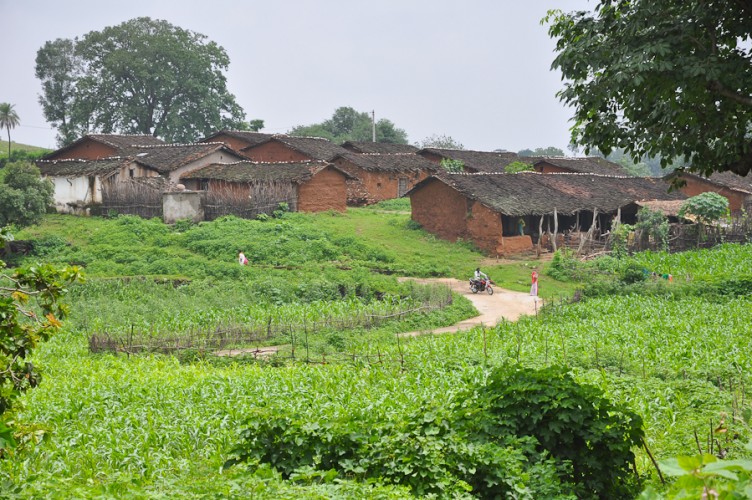
Hamlet in Bedawal village of Salumber region in Udaipur district
Our History
Basic Healthcare Services was registered as a not-for-profit trust in the year 2012 by a group of public health practitioners, academicians and development professionals, who shared the concern of poor healthcare to the marginalized communities. (for seeing the list of founding trustees, Click Here).
Grounded in the principles of primary healthcare—equity, health as a human right, and community participation—BHS set out to design services that responded to the unique realities of the people we serve, including migrants and other underserved groups. Aajeevika Bureau incubated BHS, helping it grow into an independently managed and governed organization, and continues to be a close associate.
While our early focus was on maternal and child health, we soon recognized the need for a broader scope of care. Over time, our services expanded to include tuberculosis treatment, chronic respiratory diseases, and other non-communicable diseases. More recently, we have integrated mental health and physiotherapy into our model of care.
From a single clinic in 2013, BHS has grown into a network of six non-profit AMRIT clinics and a government Primary Health Centre managed through a public–private partnership—always rooted in the principles of people-centered care and human dignity.
Peek into scenes of our early work through this short film!
https://www.youtube.com/watch?v=8-kQjKMiBhA&pp=ygUOYW1yaXQgY2xpbmljaXM%3D