- 0294-2453392
- info@bhs.org.in
- Badgoan Road, Udaipur - 313001

Amrit Clinics
Realizing the need for accessible, migrant-friendly, and low cost primary health care services in underserved areas, BHS has established a network of six “AMRIT Clinics” each serving a population of approximately 15,000. In these areas, public systems have limited reach, and the illness load is high.
The AMRIT Clinics provide low cost, high quality health care with dignity to the remote, rural, and underserved populations. Each clinic is set up in a community building following a discussions with community leaders and members
At the core of the AMRIT ecosystem, are highly skilled nurses purposefully selected from historically marginalized tribal communities. Their deep-rooted connection to the rural context enhances the delivery of nuanced and personalized care within AMRIT Clinics. The nurses are further complemented by a cohesive team of community health workers, and a cadre of women volunteers (Swasthya Kirans), all hailing from the very communities they serve. A visiting physician provides the clinical support, training, and supervision.
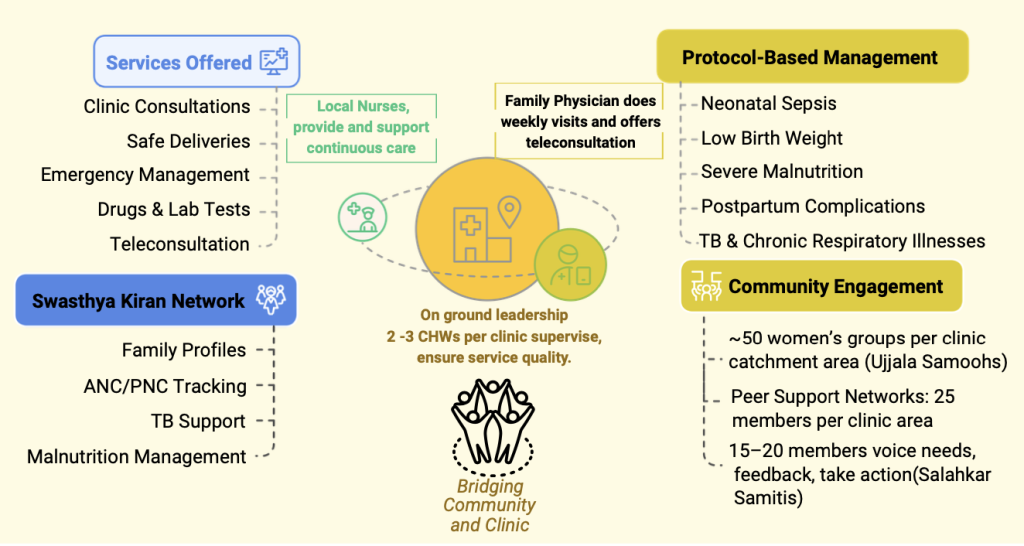
Our Amrit services include, clinic consultations, drugs and lab tests, emergency and maternity services, referrals for secondary and tertiary care, home-based care for mothers, newborns and patients with chronic illnesses, outreach services (ANC, PNC, health education and promotion). These services are complemented by focused interventions addressing maternal and child health, tuberculosis and chronic respiratory disease management, mental health and physiotherapy, and nutrition.
This comprehensive spectrum of preventive, promotive, and curative healthcare services is offered utilising a blend of innovations in human resources, technology.
HR Innovation:
Most primary care systems rely on physicians or on community health volunteers. While physicians are rarely available to live and work in remote and rural areas, community health volunteers have limitations in their ability to function independently and in the range of services they can provide.
In AMRIT Clinics, Skilled Nurses are the prime care providers and primary care managers. There is a downward integration with community volunteers and an upward integration with a Family Physician. Nurses are more available to work in remote areas, and they have the basic education and skills to provide primary curative care provided they are skilled and supported.
Partnership innovation:
Many primary care systems are not well utilized because of the weak linkages with higher levels of care. AMRIT Clinics forge social contracts with private hospitals to provide near free referral care. This has led to several lives saved, increased confidence of the families in primary care, and fulfilled social obligations of the private sector. The Clinics also forge contracts with the public system to enable targeting of health entitlements to families, such as for free diagnostics and conditional cash transfers. health through meaningful partnerships with other community-based organizations and institutions we try to address the broader social determinants of health as well.
Technology innovations:
Telemedicine and other technology based solutions often aim to substitute the presence of skilled providers. AMRIT Clinics use technology as an enabler to allow nurses to provide high quality care, rather than as substitutes. The Clinics use low cost, appropriate technology to ensure reduced needs for unnecessary referrals.